
You know that person, two weeks at the gym and already correcting your form. Three cooking videos in and suddenly restaurants are beneath them. One self -help book and now they're everyone's therapist.The less they know, the more confident they sound. Meanwhile, actual experts say "it's complicated."
That's not an accident. That's the Dunning-Kruger Effect.
What is it?
It's a cognitive bias where people with limited knowledge massively overestimate their own ability. Beginners think they're experts. Real experts know how much they still don't know.
Psychologists David Dunning and Justin Kruger proved this at Cornell in 1999, people who scored in the bottom 25% overestimated themselves by 50 percentile points. Why? Because the skill you need to judge yourself is the same skill you haven't built yet.
Meet Kabir. Three cooking videos in, he texted the family WhatsApp: "Restaurant food is so unhealthy. I've done my research. Home cooking only. I can teach everyone."
His mother, 30 years of cooking, just put her phone down. His friend Meera, a nutrition graduate, tried to explain. Kabir cut her off: "You're overthinking it." That WhatsApp message? That's the Dunning-Kruger Effect in its purest form.
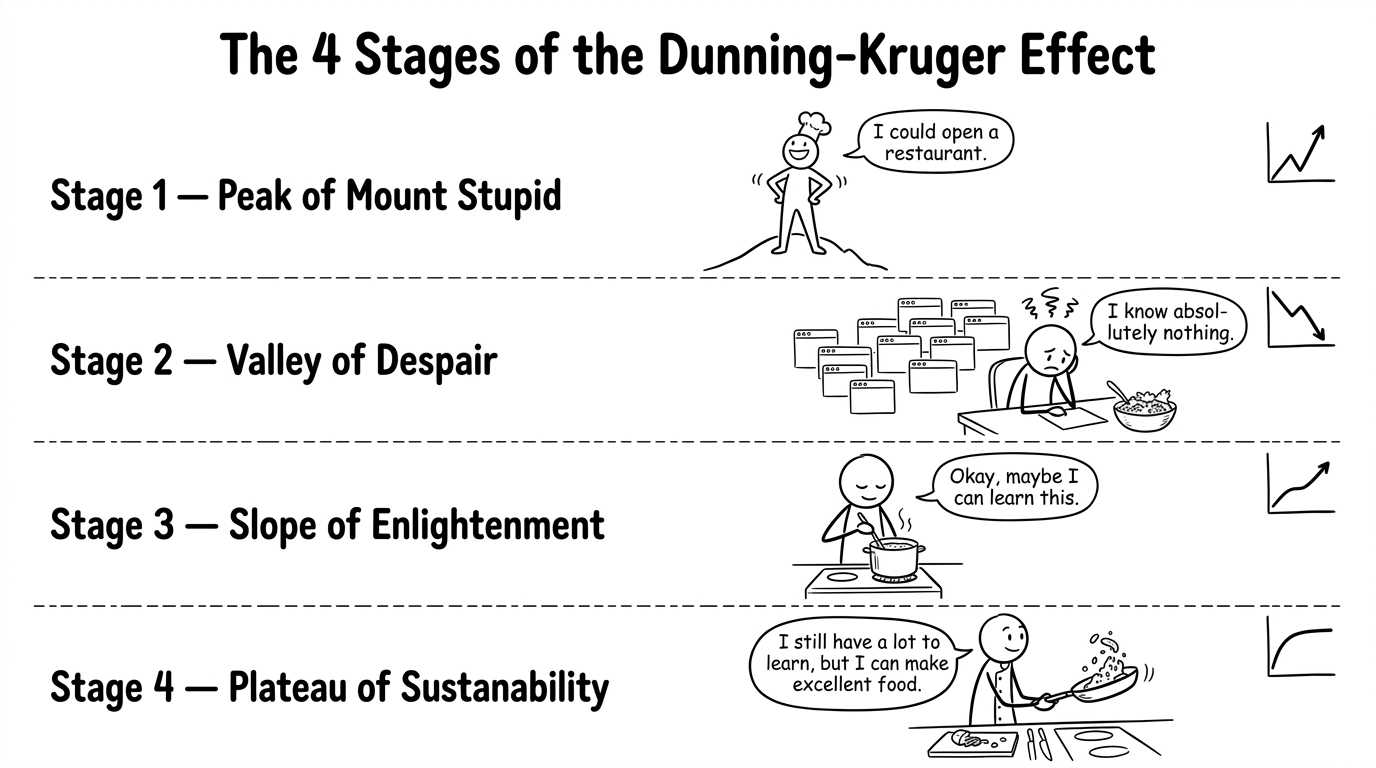
The 4 Stages of the Dunning-Kruger Effect, Kabir's Journey
Almost everyone goes through these four stages. Every single time they learn something new.
Stage 1: "I've Totally Got This"
Six videos. Two pastas. One dal that was technically edible. Kabir is ready to open a restaurant. He's correcting people at dinner parties. He's skipping his mother's rajma to cook his own version. It tastes like disappointment. He posts it anyway, good filter, bad food.
This is Mount Stupid. A little knowledge, maximum confidence, zero awareness of what you're missing. The dangerous part? It feels amazing here. Everything seems simple. Everyone else seems to be overthinking. They're not. You just can't see it yet.
Stage 2: "Oh God. I Know Nothing."
Thai curry. Dinner party. From scratch. It's a disaster. That night Kabir falls down a rabbit hole, knife technique, heat control, acid balance, flavour layering, timing. He opens 14 tabs. Closes all 14. Stares at the ceiling.
This is the Valley of Despair. The crash after the high. Confidence hits zero because you've finally learned enough to see how much you don't know. Most people quit here. Don't. This feeling isn't failure, it's the first sign of real learning.
Stage 3: "Okay, I'm Actually Getting Better"
Kabir stops cooking to impress. Starts cooking to learn. Same dal. Ten times. Until it's right. He asks his mother questions, real ones and actually shuts up long enough to hear the answers. Slowly, things click. Not everything. But enough. His confidence comes back, but quieter this time. Grounded. He says "I'm still learning" and means it instead of performing it.
That's the difference between Stage 1 and Stage 3. Same words. Completely different person.
Stage 4: "I'm Good. And I Know How Far I've Come."
A year later, people request his food. He doesn't correct anyone anymore. He doesn't need to. At a dinner party, a guy, one week into cooking, starts explaining why restaurants are all wrong and home cooking is so simple. Kabir looks at Meera. They smile.
That smile is Stage 4. Not just skill, but the quiet, unshakeable memory of every stage it took to get here.
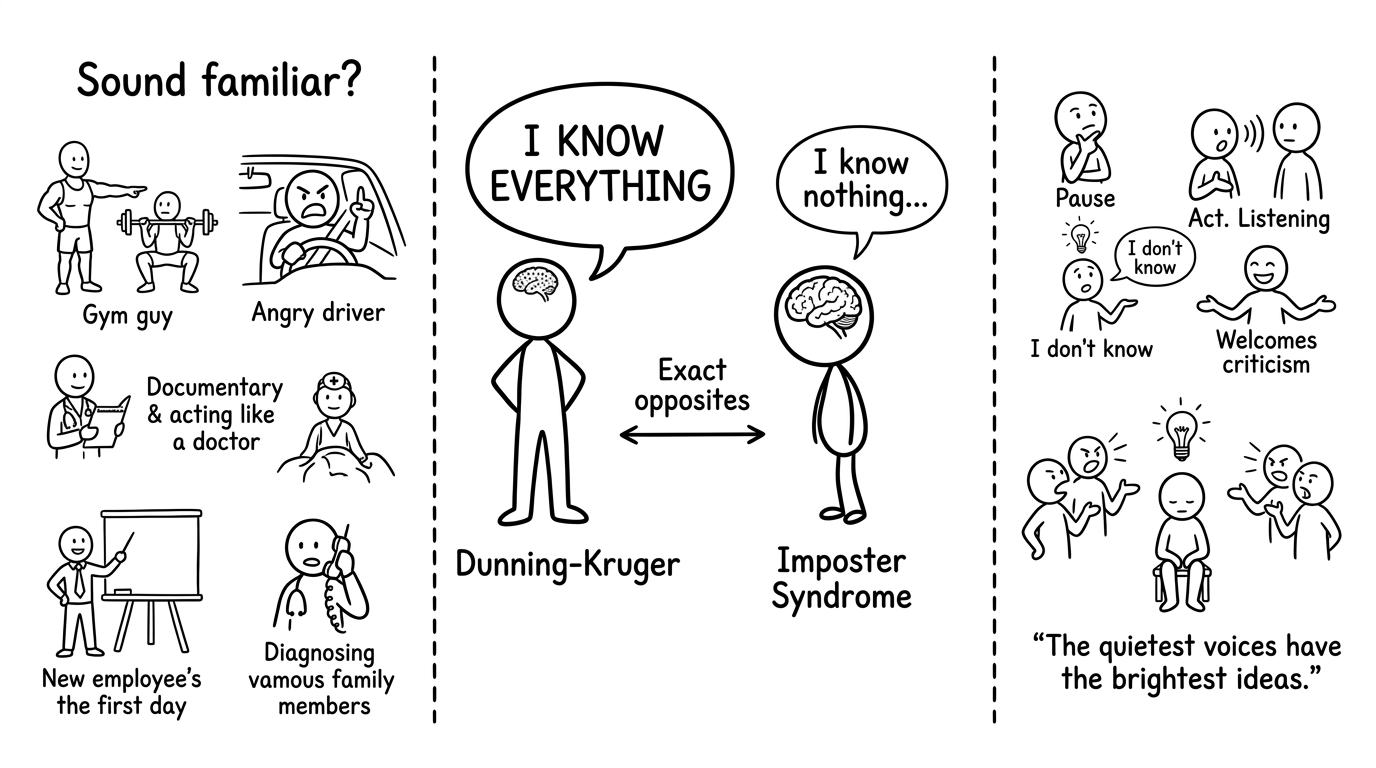
Dunning-Kruger Effect, You've Seen This Your Whole Life
Now that you know the name, you can't unsee it. The gym guy, two weeks in, fixing your squat form. The new driver convinced every other person on the road is an idiot. The colleague who joined last month and already has a complete plan to restructure the department. The person who watched one health documentary and uninstalled every restaurant app. The one who had three therapy sessions and is now diagnosing the entire family group chat.
We laugh. But here's the honest part, we've all been that person. In some area, at some point, we were loudly confident about something we barely understood. That's not a character flaw. That's just being human. The only truly dangerous version is staying stuck in Stage 1 forever. Never getting questioned. Never getting curious. Never moving past the hill.
Dunning-Kruger vs Imposter Syndrome, One Line Eac
These two are exact opposites and both worth knowing:
Dunning-Kruger: you know very little, feel very confident. Beginner acts like expert.
Imposter Syndrome: you know a lot, feel like a fraud. Expert doubts themselves constantly.
Here's the irony: if you're worried you might have the Dunning-Kruger Effect right now, you probably don't. The people most trapped by it never stop to ask.
How to Not Be Kabir Forever
You can't fully escape this effect. But you can catch yourself early. Pause when you feel unreasonably confident about something new. Find people who genuinely know more and actually listen instead of waiting to respond. Say "I don't know" out loud more often. It sounds like weakness. It's actually intelligence. Welcome the person who criticises you. They're doing what most people won't. Most importantly notice the difference between performing knowledge and having it. One sounds loud. The other doesn't need to.
So, which stage are you in right now?